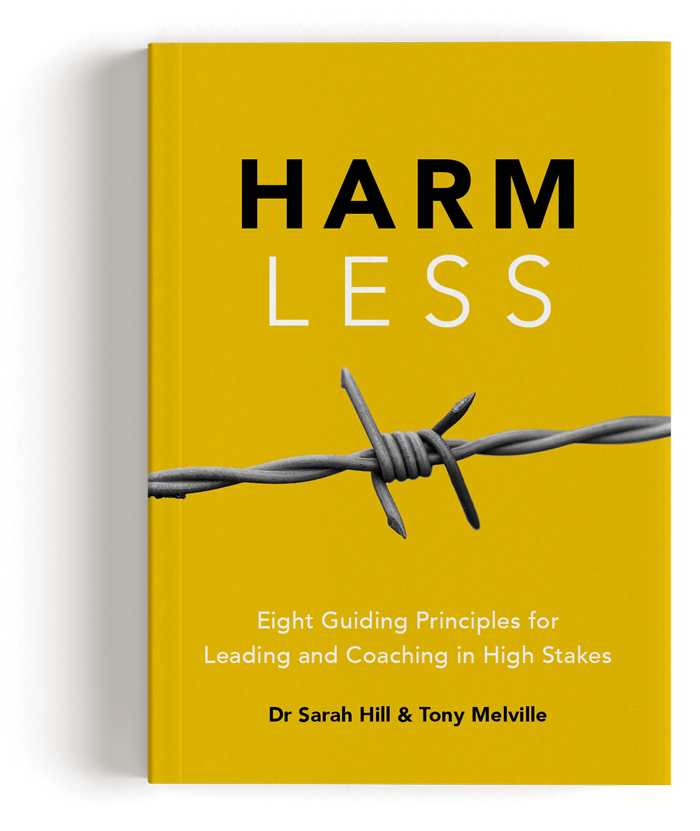
Harm Less.
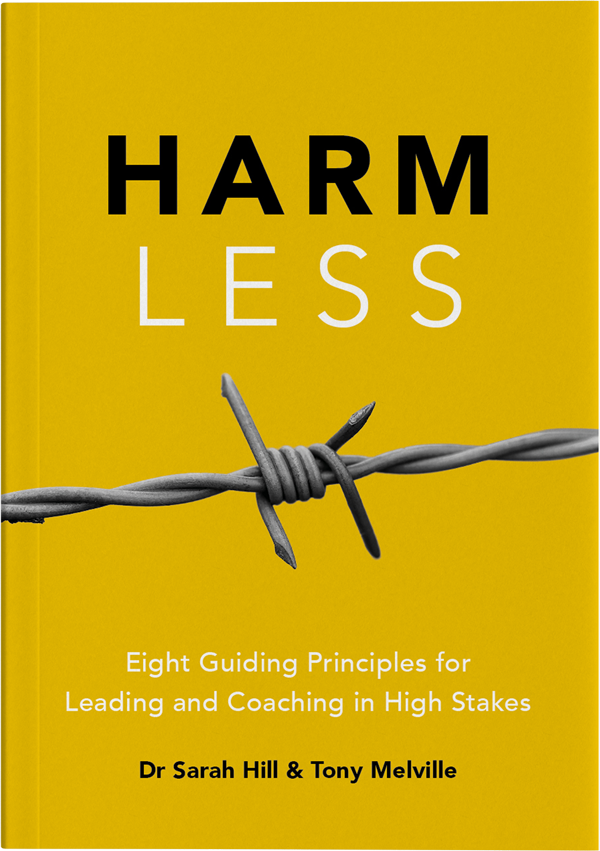
Eight Guiding Principles for Leading
and Coaching in High Stakes
ABOUT THE BOOK
Will you harm less?
Even the best leaders and coaches — no matter how technically brilliant, how likeable, how emotionally intelligent, how respected, how well-intentioned — can cause harm when the stakes are high and they are not in command of their behaviours.
They might blame and shame. They might lash out. They might shut down constructive opposition. When leaders — and the coaches that guide them — are unable to control their reactivity under pressure, they can inflict harm at an individual, team, organisational or even systemic level.
In Harm Less, Dr Sarah Hill and Tony Melville draw on decades of joint coaching experience, as well as leading organisations themselves, to outline eight guiding principles which help leaders and coaches develop the awareness and behavioural range to respond more effectively when the pressure is on.
Through deeply personal storytelling and practical takeaways, Sarah and Tony make a bold promise: when leaders and coaches apply these principles in high stakes moments, they will reduce the amount of harm in the world.
TESTIMONIALS
In their words.
“Harm Less is a smart, helpful and thought-provoking read.”
Douglas Stone and Sheila Heen
Co-authors of New York Times bestsellers Difficult Conversations: How to Discuss What Matters Most and Thanks for the Feedback: The Science and Art of Receiving Feedback Well.
“Using many true-to-life examples, Hill and Melville provide sound advice for leaders and consultants on how to get people listening and learning from each other when the stakes are high.”
Gervase R. Bushe, PhD
Professor of leadership and organization development at Beedie School of Business, Simon Fraser University, and author of Clear Leadership: Sustaining Real Collaboration and Partnership at Work.
“Anyone doing work with teams will find this book an invaluable read.”
Dr Paul Lawrence
Director of Leading Systemically and Team Coaching Collective.
WHERE TO BUY
Get your copy.
Change begins with a different conversation. Order Harm Less online.
LAUNCH EVENTS
Hear from the authors
An hour long virtual session providing an opportunity to hear Sarah and Tony talk about why they wrote Harm Less and what has informed their creation of the eight guiding principles they’re calling leaders and coaches to attend to when under pressure. With plenty of space for questions and exploration, we’d love to see you there!
USA & Canada
Hosted by Kari McLeod
Thursday 21 January 2027
8pm GMT / 3pm EST / 2pm CST / Noon PST
UK & Europe
Hosted by Paul Williamson
Monday 25 January 2027
2pm GMT / 3pm CET / 4pm EET
Australia & Pacific
Hosted by Paul Lawrence
Thursday 11 February 2027
8m GMT / 7pm AEDT / 9pm NZT / 4pm AWST
Register Interest
Complete the form below to register your interest in any of these events. We’ll be in touch with information on how to attend.
All fields required
BOOK EXTRACT
Tame your shadow behaviour
Imagine yourself when you’re behaving at your worst.
Something has happened which has put you under pressure. You’re reacting in the moment.
Stress is showing internally (this could be a tightening of the chest and rising heart rate) and externally (for example, faster and louder speech, or your eyes glazing over).
Without an intervention — such as a Bystand — to stop your reactivity in its tracks, you reach boiling point.
The ultimate outcome could be verbally lashing out, physically confronting someone, humiliating another person, or using humour in an aggressive, sarcastic or inappropriate manner. On the other end of the scale, the outcome could be non-verbal: becoming mute and refusing to engage in an interaction. Picture, for example, being asked a question and turning your back — literally — on the person who is trying to communicate with you.
This reactivity is what we call shadow behaviour.
Shadow behaviour is the conduct emanating from high stakes triggers — the things that push our buttons — that reveals our darker side. It’s a reaction that can build over time or escalate rapidly, like lighting a touch paper. The triggers are uniquely personal. They can range from being presented as someone who has low integrity to having your ideas ridiculed in a public setting; from losing a substantial portion of your retirement savings to losing out on a bonus because of someone else’s incompetence, or perceived incompetence. Our negative reactions to such triggers are what most people work hard to keep hidden.
But shadow behaviour can come out in all of us when the pressure is on…
‘I belittled Sarah in front of 30 people… and it came from the smallest trigger’
Tony Melville, co-author
Usually, my trigger is feeling like I’m not being listened to, or understood. This relates to my Childhood Story, a theme we outline in Chapter 4. I am continually working on myself so I can navigate these triggers and prevent shadow behaviour showing itself. Nine times out of 10, I can do just that. I have learned to spot I am moving into shadow behaviour by noting the language I use. For example, I have realised that when I use the phrase “for the avoidance of doubt”, it is a sure-fire sign I am moving into high stakes. Noticing this enables me to Bystand myself, which at the very least gives me the opportunity to make a different behavioural choice in the moment.
But this work is not easy and I’m not always successful. Anyone can be caught out, at any time. In our early days working together at Dialogix, for example, I belittled Sarah in a room full of people, leaving her in tears. And it came from the smallest, most mundane trigger.
We had been running a week-long retreat at a country house for a global leadership team of 30 executives. It had been an extremely challenging and intense programme: it was about changing behaviours in high stakes scenarios and naturally, there were a number of behavioural breakdowns within the team. As interventionists, we welcome this as it gives us a platform to address those behaviours — but it’s still demanding work.
On the final day, I was at the front of the room, with a screen behind me, explaining a point to the group before I sent everyone away to do a practical task. This was a time when we were trying to simplify, and add to, David Kantor’s structural dynamics model. It was difficult work and I was feeling stressed. But I delivered what I thought was a good explanation of the theory.
Sarah, who was sitting on the right-hand side of the stage as I presented, then chipped in with an additional comment. In my mind, she was needlessly repeating something I had already said. From her perspective, it was reinforcement.
As I said above, it was the smallest, most mundane trigger. But without even realising, I had fallen into shadow behaviour. I looked across at Sarah and shot back:
“If I want your help, I’ll ask for it. Thanks.”
It wasn’t just the words, it was the dismissive tone of voice. I could see the tears in her eyes and carried on with my presentation. Even to this day, I feel mortified when telling this story. It is shameful on a personal level — I undermined and upset my closest colleague and business partner — and also on a professional one. As a behavioural interventionist, I was in the room for a sole reason: to help clients avoid falling into dysfunctional behavioural patterns in high stakes situations. And yet here I was doing exactly that on a stage right in front of them!
Thankfully, there wasn’t long to go before they were sent away to do the exercise. Sarah and I were able to have a moment to get ourselves out of high stakes, do a Bystand, discuss what happened and for me to apologise. Without doing this, it could have laid down a structural imprint on our relationship, affecting how we interacted with each other going forward.
‘Moral righteousness took over. I stormed out of the director’s meeting’
Sarah Hill, co-author
My high stakes triggers are feeling like I am not being protected, not being looked after and not being loved. Like Tony — like anyone else — this relates to my Childhood Story. When I am not in command of these triggers and shadow behaviour takes hold of me, I become mute. I may be physically present, but I will detach emotionally. I stop myself feeling anything. It might happen at a moment when other people need me to step up and give voice to something, but I’m unable or unwilling to do so. As the pressure builds, it leads to withdrawal, sometimes dramatically so: “I’m out, I’m done with this relationship.”
This once happened at an important director’s meeting, of all settings. It was earlier in my career, at a different organisation to Dialogix, and it was underperforming. The chair of the organisation, who I will call Frederick, was a leader who I worked with for many years, and deeply admired. But because of the underperformance, he was in high stakes and his shadow behaviour was on full display. He was unpacking what he thought was going wrong in the organisation, criticising Fiona, the CEO, and Jon, another director. Turning to me, he added: “And you, don’t think I’m not coming to you.” High stakes trigger? Activated.
The exchange culminated in Frederick offering Fiona’s CEO job to Jon… while they were sitting next to each other! It was madness. Everyone in the room was in a frenzy. Fiona was shouting and swearing at him, as was Jon. I, on the other hand, went mute, not saying a word. I was a maudlin victim, holding moral righteousness: “Why is he doing this? It’s so unfair! We’re a good team. I thought he cared about me, about us. We don’t deserve this.”
Without even realising. I was on my feet. I stormed out of the room and slammed the door behind me. It was like a fighter pilot triggering the ejector seat.
Up to this point, I had done a lot of work on myself and leading in high stakes. Going into this meeting, I had known there was a risk that I would have the impetus to get out and save myself. I was determined not to. And yet here I was, sitting in the back yard of the building, thinking: “Now what do I do?” I was embarrassed, ashamed, but there was nowhere to go. I went back to the meeting room and popped my head round the door. Frederick was laughing: “Get your ass back in here.”
My reaction had temporarily broken the tension. But thankfully, we didn’t leave it at that. Each of us had the skill to review what had just happened to ensure no lasting damage was done. Frederick, who had lowered his own stakes with a frank Bystand about his behaviour in the meeting, eventually asked me: “If you had spoken, what would you have said?” I found my voice and explained. He responded: “It would have been so helpful if you had said that at the time. It could have changed everything.”
Even accounting for his own shadow behaviour which had triggered my reaction in the first place, he had a point.
Quite simply, shadow behaviour is the actions and reactions we are least proud of ourselves for. Absolutely no one is immune to it. And not only is it dysfunctional, it’s also profoundly sad on a human level.
But it’s also important to understand that shadow behaviour is a protective mechanism.
Imagine if someone suddenly approached you with their fist raised, as if to smack you in the face. Your instinctive response would be to protect yourself: whether by ducking, taking a step back or raising your own hand to block the punch. Shadow behaviour is a bit like this response. It’s an unconscious shield against something “bad” — a high stakes trigger — that is happening to you. Quite often, the triggering event reminds us of a previous experience where harm happened, so we react to keep it at bay, either by lashing out or shutting down…
MEET THE AUTHORS


FREE RESOURCES
Keep exploring.
Discover a selection of freely shared resources.